I walked into a 25-minute appointment that would decide whether my struggles count. The doctor tested my reflexes and checked my coordination. She wrote "unremarkable." I was rejected.
In Austria, there's something called a Behindertenpass, a disability pass. If you get one, it opens up financial support, job protections, and access to services. For someone who has spent the last decade trying to hold things together through university, job applications, and just daily life, it would mean something real. It wouldn't fix everything. But it would mean the system actually sees you.
I applied three times. Rejected every time.
Why I applied
Here is what my life actually looks like.
I've been blind in one eye since childhood. Multiple surgeries. On top of that, I have ASD and ADHD. That combination touches everything: how I take in information, how I deal with noise and light, how I talk to people, how I get through a day. I've been in psychiatric treatment for over ten years. I've tried more than twenty different medications.
I spent five years at university. I repeated courses over and over, not because I didn't understand but because the environment broke me: the fluorescent lights, the noise, the group work, the crowds. My brain processes things differently and nobody built that place for someone like me. I had to stop eventually.
I've applied for over 542 jobs in eight years. The ones I could actually do, I got rejected from. Sometimes after interviews where they told me I did well. No reason given. The jobs in open offices with constant noise and social pressure, I can't survive in those. Add the eye problem and the options shrink to almost nothing.
I moved four times because the sensory environments in those apartments made it impossible to function.
The disability pass would give me tools, not a cure. Just some leverage to navigate a system that is grinding me down. Without it, I have conditions that affect every part of my life, documented by my own hospital, and zero recognition that would unlock any kind of support.
That's why I applied. Because I need someone to look at the evidence and say yes, this counts.
What my hospital says
I've been a patient at one of the biggest public hospitals in Austria since 2015. They wrote this in their official report:

Hospital report (Patientenbrief): "Die medikamentöse Therapie wurde oftmals umgestellt und ist ausgeschöpft." (The medication therapy has been adjusted multiple times and is exhausted.)
They also wrote this:

"Eine ausreichende Stabilisierung... konnte, trotz verschiedener Augmentierungsversuche und begleitender Psychotherapien, nicht zufriedenstellend erzielt werden." (Adequate stabilization could not be satisfactorily achieved despite various attempts.)
And this, about medication changes producing no lasting results:

"Es konnte zumeist keine längerfristige bzw. ausreichende Verbesserung der AHDS Symptome erreicht werden." (Mostly no lasting or adequate improvement could be achieved.)
What the disability assessment says
The evaluator had all of this in front of her. She read the same hospital reports. And here is what she concluded:
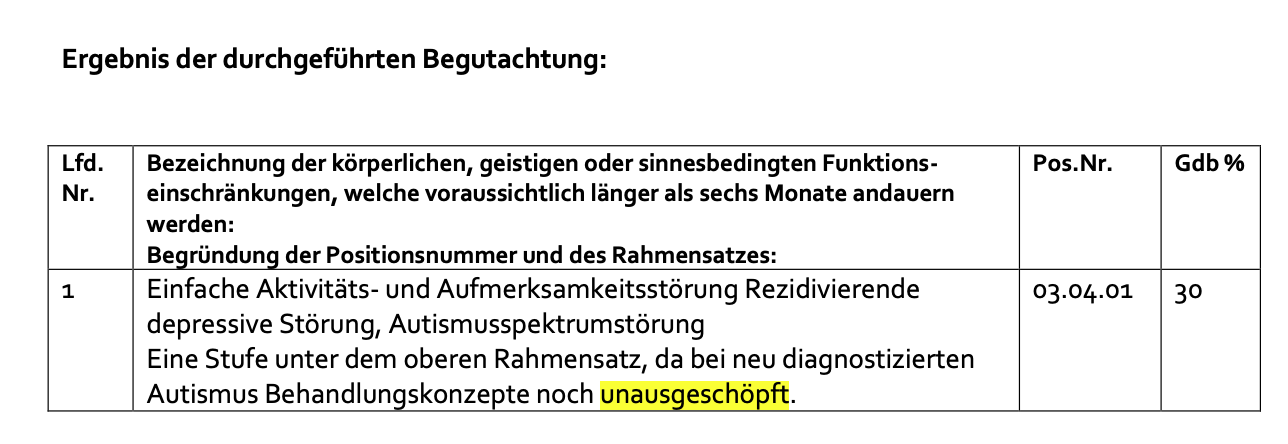
"Autismus Behandlungskonzepte noch unausgeschöpft." (Autism treatment concepts not yet exhausted.) Result: 30% degree of disability.
My hospital says treatment is exhausted. The evaluator says it's not, on the same records, ten weeks apart.
What she wrote about my behavior
And here is the behavioral observation she wrote during the same 25-minute appointment, used as part of the same assessment that produced the 30% verdict:
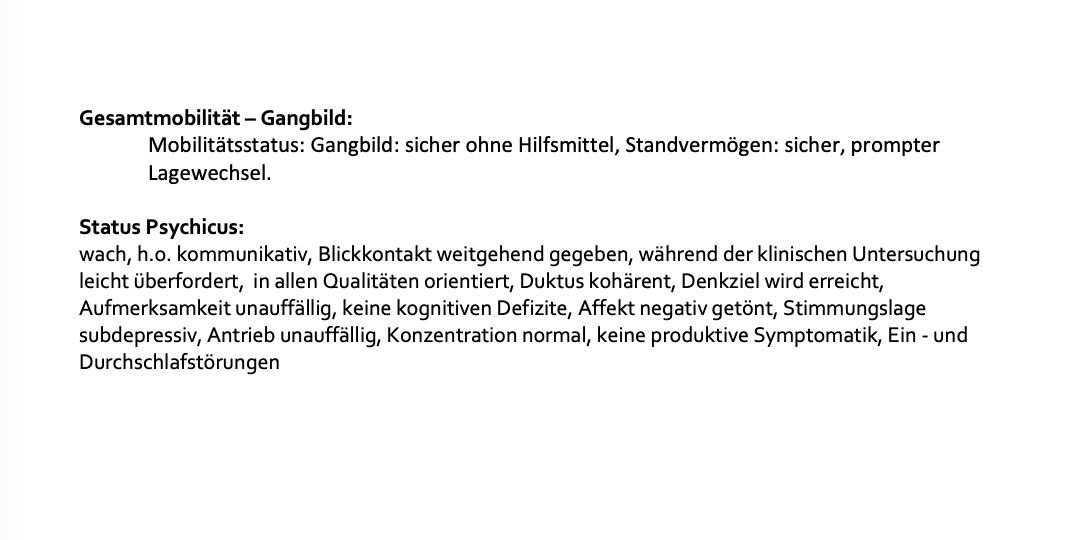
Status Psychicus, assessment report (Gutachten), page 6: "communicative, eye contact largely present, attention unremarkable, no cognitive deficits, drive unremarkable, concentration normal." She also noted I was "slightly overwhelmed during the clinical examination" (leicht überfordert) and recorded it next to "attention unremarkable" without integrating the two.
This is precisely what masking is: sitting still, speaking the dominant language well, maintaining eye contact because you have learned that not maintaining it gets read as evasive, holding concentration through a 25-minute appointment you prepared for, in a language you have studied for years.
These are some of the most documented features of late-diagnosed autistic adults, adults who have spent decades learning to look unauffällig to survive. They are autism doing what it does in people who have had to become invisible.
An assessor whose mental model of autism is "someone who cannot speak, cannot sit still, cannot make eye contact" looks at someone who can, concludes nothing is there, and writes unauffällig. That is what happened here.
Who evaluated me
The woman who made this decision is a neurologist. Her publicly listed specializations: epilepsy, Parkinson's, stroke, restless legs, headaches, vertigo. No mention of autism, ADHD, or neurodevelopmental disorders.
She spent 25 minutes with me. She tested my reflexes. She checked my coordination. Those tests tell you nothing about how autism affects someone's life: nothing about sensory overload, executive dysfunction, or what it takes to get through a day. She looked at me, saw someone sitting calmly in a chair, and wrote "unremarkable." Then she overruled a decade of documentation from the hospital that actually treats me.
The first time, maybe you call it a mistake. But I appealed. I sent in the hospital report that directly contradicts what she wrote. She read it and dismissed it. She said autism therapies were "still open" and rehabilitation was "reasonable." The hospital that treats me says we've tried everything. She says we haven't. This is not her field. She is overriding the specialists who actually know my case.
The eye got accepted. The autism didn't.
I have an eye problem. Over ten surgeries. Blind in one eye. When the evaluator looked at my eye, that was the end of it. She documented what she saw and moved on, no argument, no "maybe try another treatment," no pushback. She saw something wrong and wrote it down.
Then she got to the autism. I showed her reports, the diagnosis, ten years of treatment records from the hospital that treats me. She argued with it, questioned it, overruled my doctors.
She couldn't see it.
I've also spent my whole life learning to hide it. That's the thing that really gets to me. I sit calmly because I taught myself to, I speak German well because I practiced it obsessively, and I look fine because if I didn't, the world punished me for it. And now that skill, the thing I built just to survive, is the reason they don't believe I'm struggling.
She used a method designed for physical conditions: look at the person, check the reflexes, note the behavior. That method cannot detect autism. She used it anyway, and when it showed nothing, she concluded nothing was wrong. It is a process that, by design, fails people like me. Nobody said anything hateful. They just never used the right tools.
What it's like when they can't see it
Autism doesn't show up in a reflex test. It shows up at 2 a.m. when you're still awake because the neighbor's washing machine vibrates through the wall and you can't stop hearing it. It is there when you move apartments for the fourth time because the sound environment made it impossible to think, and in five years of repeating university courses because your brain refuses to process things the way the system expects. It shows up when a simple phone call takes an hour of preparation and leaves you drained for the rest of the day.
None of that is visible in a 25-minute appointment. Especially when you've spent your entire life learning how to look normal. The evaluator saw someone who seemed calm and spoke well. She wrote "unauffällig." Unremarkable. That's what masking looks like from the outside. From the inside, it costs everything I have.
Three rejections
The first time, I was rejected. I appealed.
Second time. I sent in the hospital report that directly contradicts the evaluator. Rejected again.
Third time, at court level. The judge wrote there were "no doubts about the consistency" of the assessment. No oral hearing. Nobody talked to me. The report from my own hospital, the one that says treatment is exhausted, was in the file. It didn't matter.
Then, ten weeks later, something happened that made all of it worse. A different department of the same state sent me to a different doctor, working from the same medical records, the same hospital files, the same patient. This doctor found something different: concentration reduced, energy and motivation reduced, treatment options exhausted. She said I needed significant ongoing support and that this need would very likely not go away. They approved me for care on the first try, no fight. She looked at the evidence and saw what was there.
So what was the point? Three rejections from one office, and another office looks at the exact same paperwork and approves me immediately. What does "you can appeal" actually mean when the appeal never changes anything?
When I escalated the complaint
I escalated the case to the state disability ombuds office, the body whose mandate covers exactly this kind of complaint. My complaint was specific: the evaluator was unqualified for autism, and she had ignored every report from the hospital that has treated me for ten years. That was the question I was asking.
The reply explained, at length, the legal distinction between Pflegegeld (which I had been approved for) and the Behindertenpass (which had been denied), as if I had confused the two. I had not.
The reply: a technical explanation of why Pflegegeld and the Behindertenpass are different processes with different legal frameworks. I had not asked about that.
I am not complaining that Pflegegeld was approved. I am complaining that the disability assessment was botched.
The same dynamic runs through the rest of the case: the evaluator who saw a calm patient and overrode a ten-year hospital record, the court that wrote "no doubts" without speaking to me, the ombudsperson that responded to a question I had not asked.
What the appeals did to me
Nobody talks about what the process itself does to you.
Every appeal means going through everything again: digging through documents, reading the same rejection letters, writing another statement trying to explain, one more time, why the evidence should matter. And the whole time you're caught in this trap: if you sound too emotional, they dismiss you. If you sound too calm, they say you're fine.
For someone with ASD and ADHD, this isn't just frustrating, it's destructive. Organizing documents is already hard for me, and so are meeting deadlines and understanding legal language. Doing all of that while emotionally wrecked from the last rejection is close to impossible. Every time they said no, it pushed me further down. Every appeal took weeks of energy I didn't have. And at the end, the answer was always the same.
I did this alone. No lawyer. No money for one. No network of people who understood the system. Just me and my documents and the slow realization that the amount of evidence didn't matter. The system was built to process, and if the process says no, it says no.
How this feels
You can't prove autism by showing it in a room. You can only prove it on paper: through years of treatment records, through the words of doctors who actually know you. When all of that is set aside because someone who spent 25 minutes with me wrote "unremarkable," the conclusion is hard to avoid: the method used was never capable of seeing what it was meant to assess.
The process carries a cost of its own. Each appeal meant going through everything again, on top of conditions that already make documents, deadlines, and legal language hard. It took energy I did not have, and the answer from that office was always the same.
I did it alone, without a lawyer. What I am left with is the record. The evidence exists, it is documented, and I am not stopping.